


The Local Guide to Minimum Orders, Setup Fees, and Artwork for Custom Apparel
- Megan Robnett

- May 4
- 11 min read
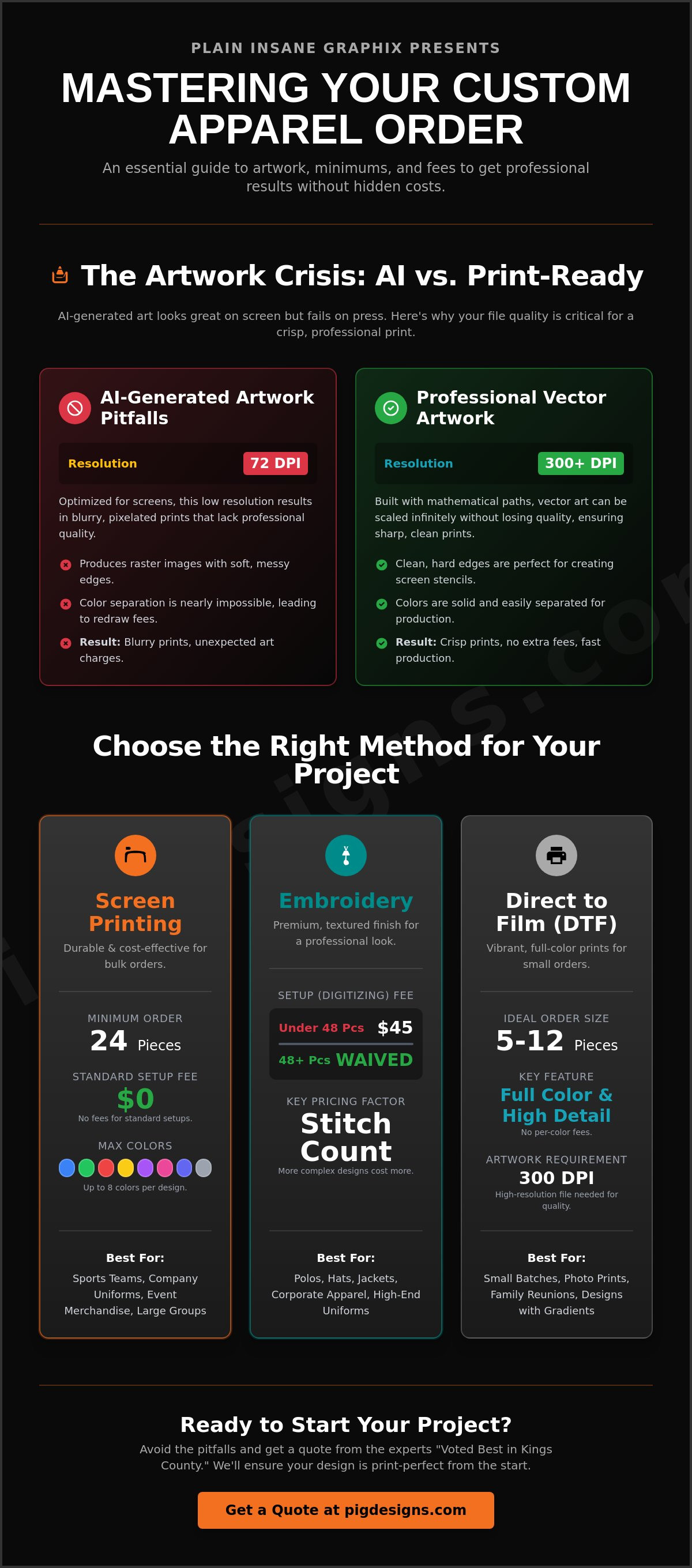
That AI-generated logo you made might look great on your phone, but it is likely the reason your last t-shirt order looked blurry. Most AI art exports at a low 72 dpi, which is why AI artwork doesn't work for silk screen where we need 300 dpi. At Plain Insane Graphix, we don't want you surprised by extra fees on your invoice. Mastering Minimum Orders & Setup Fees for your custom apparel is how you get professional results without blowing the budget.

It's frustrating to open a quote and see unexpected fees. You want durable uniforms for the Central Valley heat and sharp polos that represent your brand. This guide breaks down these technical hurdles. We are laying out the rules of the trade so you can get the gear that earned us the title of Voted Best Print and Graphics Shop in Kings County.
Key Takeaways
Master the technical side of Minimum Orders & Setup Fees to save money on your next custom apparel order.
Learn why keeping your silk screen designs under 8 colors prevents your setup fees from skyrocketing and ensures a cleaner, more durable finish for your custom hoodies.
Understand the digitizing process for embroidery and how your total stitch count directly influences the labor time and final price of your professional polos.
Discover how Direct to Film (DTF) serves as a cost-effective alternative for high-detail, small-batch runs that require crisp 300 DPI resolution with transparent backgrounds.
Avoid pixelated prints by working with a local Lemoore expert who can catch low-resolution AI artwork issues before they hit the production line.
Decoding Minimum Orders & Setup Fees in Lemoore Screen Printing
Custom apparel in Kings County isn't as simple as hitting a print button on a computer. It is a physical manufacturing process that requires labor, chemistry, and precision. When you order screen printed t-shirts, you are paying for a craftsman to prepare your design for the press. At Plain Insane Graphix, we prioritize transparency because we know Lemoore business owners hate unexpected line items. Understanding the relationship between Minimum Orders & Setup Fees in t-shirt screen printing helps you plan your budget effectively.
Each color in your design requires a separate physical stencil. This is why screen printing is a labor-heavy tradition. A screen setup fee per color is a one-time labor charge for creating the physical stencil used to transfer ink to your garment and is pretty standard for silk screen shops, ranging fro $15 to $30 per color. Plain Insane Graphix has built our reputation as the "Voted Best in Kings County" by offering standard silk screen setups with no fees. We focus on the quality of the print rather than nickel-and-diming our neighbors for the physical labor of burning screens and mixing inks.
Why Minimums Quantities Matter for Silk Screen
Why do we require a 24-piece minimum for screen printing? It comes down to the math of the press. It takes roughly the same amount of time to set up a job for 5 shirts as it does for 50. For Hanford sports teams or Lemoore High School events, ordering 24 pieces or more ensures the labor cost is spread out, lowering your per-shirt price significantly. If you only need 5 to 12 pieces for a small family reunion, we often recommend Direct to Film (DTF). These methods don't require the same intensive setup, making them more affordable for small runs while still delivering that professional look.
Maximum Colors for Silk Screen
How many colors can you actually put on a shirt? It all depends on how many screens the machine in the print shop has. Each additional color requires a separate physical setup, which directly increases your invoice total. When you're planning your budget, mastering the details of minimum orders & setup fees or garment decoration, is the best way to keep your costs down and avoid pricing shock.
Plain Insane Graphix allows a maximum of 3 colors for silk screen printed t-shirts. Each color added to the garment increases the production cost of the shirt since it adds another step to the production process. To get your design onto screen-printed t-shirts, we perform color separations. Your logo is turned into individual black-and-white films, one for each color in the design.
Silk screen also doesn't allow for mixed gradients in the print or for printing fine details found in a photograph. We can use halftones, which are tiny dots, to create the illusion of gradients, but simple is usually better. If you would like to use mixed color gradients or photographs in your print, full-color digital silk screen or Direct To Film transfers would be better suited print methods for your project.
The best bet for silk screen printing is to use bold, solid colors which pop more and stay durable after many washings. There is nothing wrong with a single color design, they pop and they are cost effective. If you aren't sure if your art is ready, you can always contact us so that we can take a look at your artwork.
Embroidery Setup Fees: Digitizing and Stitch Count Explained
Embroidery is where the technical expertise of Plain Insane Graphix truly sets us apart from online vendors. Unlike screen printing, we aren't burning screens or mixing inks. Instead, we are mapping thousands of individual thread paths to create a durable, professional look for your Lemoore business. To get this right, you have to understand how the stitch work interacts to create your final quote.
What is a Digitizing Fee?
Think of digitizing as the high-tech blueprint for our embroidery machines. You can't just "upload a file" and expect the machine to know where to go. A human digitizer has to manually plot every needle drop, determining the direction of the stitches, the tension of the thread, and the order of the colors. This is why we charge a one-time $45 fee for standard designs (large designs for things like letterman jackets or jacket backs may cost more). It is the labor of translating raster and vector images into a language the machine understands.
Be wary of online embroidery services, many use an automatic tracing setup feature in their
embroidery program to do setups, or use outside digitizing services which do not use human made embroidery setups. This causes bad setups that cause issues with the embroidery machine runs, which causes bad stitches in your design.

Plain Insane Graphix not only sets everything up by hand, we also run samples of your embroidered logo to ensure it embroiders just right. Once your logo is digitized for your embroidered polos, we keep that file on hand. You won't pay that fee again on future orders unless you change your branding.
Stitch Count vs. Design Size
In the embroidery world, size isn't the only thing that matters; the density of the design is the real price driver. The stitch count tells us exactly how long a garment will spend on the machine. A typical left-chest logo for a Hanford business usually falls between 5,000 and 10,000 stitches. If you want a massive full-back design on your custom hoodies, you might be looking at 50,000 stitches or more. These high-count designs are a premium investment because they take much longer to produce and use significantly more material.
For our Visalia headwear customers, we also offer "3D Puff" embroidery on premium brands like Richardson and FlexFit hats. This technique uses a foam underlay to make your logo stand off the hat for a bold, retail-ready look, which adds an extra step in the process, which also adds cost to the design. Whether you want flat embroidery or 3D puff, knowing your stitch count helps us give you the most accurate pricing possible. Simplifying a complex logo can help lower your costs while maintaining a professional finish.
Artwork Setup for Direct to Film (DTF)
Direct to Film (DTF) has completely changed the landscape for Lemoore small businesses and local clubs that don't quite need a full run of 24 shirts. It serves as the perfect bridge when you have high-detail graphics, like a photograph or a complex digital painting, but only need a handful of units. While we've discussed the physical labor involved in screen printing, DTF is a digital-first process. There are no physical screens to burn or emulsion to dry. Instead, the setup involves prepping a digital film that receives a specialized adhesive powder. This allows for a soft-hand feel and incredible durability that rivals traditional methods.
Preparing Files for DTF Printing
To get a crisp, retail-quality print, your file must meet the strict 300 DPI resolution rule. If you pull a low-resolution image from a website, it will look blurry and unprofessional on the final garment. You also need to ensure your file has a transparent background. A common mistake we see is customers sending JPEGs; since JPEGs don't support transparency, your logo will end up with a literal white box around it on the shirt. We require high-quality PNG files to ensure only your design comes out clean. Also, watch out for fine lines; anything thinner than 0.5mm might not hold enough adhesive to survive the heat press or multiple washes.
The Problem with AI-Generated Logos
The current AI Artwork Crisis is a real hurdle for graphics and print businesses. Tools like Midjourney, DALL-E, or ChatGPT are great for inspiration, but they are often a nightmare for production. AI generates raster images full of hallucinated pixels and soft gradients. Screen printing requires hard, clean edges to create a physical stencil. Direct to Film requires a transparent background, high DPI, and crisp lines. Embroidery generally needs a simplified design, perferably in a vector format.
If your file is a blurry mess of 72 dpi pixels, we have to spend hours re-drawing it into a vector format. This labor-intensive process is why you need to understand the full scope of the setup process and the costs of setup before placing your order.
AI art is built on rasters, not the clean paths found in professional embroidery digitizing or vector design software. When we try to separate colors from an AI file, the software gets confused by the millions of tiny color variations. This leads to re-drawing fees because a human artist has to manually trace your logo to make it printable, which can cost you up to $60 an hour. If you use AI, prompt it for flat vector style or solid colors to keep your design fees low. This small step ensures your project stays on track and within budget.
Location Matters
Whether its hat embroidery or t-shirt printing, the more locations you decorate will increase the cost of your product. People come to our shop and have this idea that they will get a custom hat made with the front, back, and both left and right sides embroidered, but will be shocked at the quoted price. Each location decorated on an apparel piece costs more to produce. Time is money, so whenever the production time increases, so will the cost of the apparel. Ask yourself if all of those areas are necessary or if you can combine some of the design areas into one to save on setup and production costs.
Maximizing Your ROI: The Plain Insane Graphix Advantage
Choosing a local partner for your branding needs is about more than just convenience; it's about protecting your bottom line. When you work with P.I.G., you aren't just a number in a digital queue. You get the chance to see physical samples of brands like Richardson or FlexFit before we start the bulk run. This prevents the costly mistake of ordering 100 shirts that don't fit the way you expected. By combining your order of performance hats and team jerseys, you streamline your branding and save on logistics.
Navigating the technical landscape of your custom apparel design setup is easier with a local expert by your side. We know that Lemoore, Hanford, and Visalia businesses need results that last. Whether it is a set of safety apparel for a construction crew or embroidered polos for your agriculture based crew, we ensure the technical details are handled correctly the first time. This local oversight is why we can offer a quick turnaround of quality products that online giants simply can't match.
The 'Reliable Local Expert' Guarantee
We don't rely on faceless automation. Real humans check your artwork right here in Lemoore to catch those low-resolution AI errors before they hit the press. Our deep roots in the South Valley mean we are personally invested in the success of Lemoore High School events and local youth sports. We also specialize in seasonal community needs, like custom graduation signs and sports team banners, ensuring our neighbors always look professional. When you support a local business, that value stays within our community.
Final Checklist for Your Next Order
Before you hit the "order" button, run through this quick list to ensure you're getting the best return on your investment. A few minutes of prep can save you hours of headache and hundreds of dollars in re-printing fees. We want your experience to be super easy and convenient.
Confirm your quantity: Remember the 24-piece magic number for screen printing to maximize your value.
Check your art: Ensure your file is in a vector format or at least 300 DPI for DTF.
Simplify colors: If you are screen printing, try to stay under 3 color maximum, but fewer colors equals lower print costs.
Verify Decoration Locations: When it comes to apparel decoration locations less is less and more is more costly. Do you need all those locations decorated or can you combine the information into one design?
Verify stitch count: Ask us how simplifying a dense logo can lower the price of your embroidered polos.
Get an upfront quote: We provide transparent pricing that includes all setup and digitizing fees so there are no surprises.
Ready to get started? Contact our Lemoore team today to discuss your project and see why we are the trusted choice for custom apparel and signage in Kings County.
Get Your Project Started with Lemoore’s Best
You now have the technical roadmap to avoid pixelated logos and invoice surprises. By prioritizing vector files over low-res AI and bulk discount threshholds, you're already ahead of the competition. Mastering the details of ensures your gear looks retail-ready every time.
Since 2003, Plain Insane Graphix has helped the Central Valley stay in touch with high-quality apparel. Stop by our local Lemoore showroom to feel the fabrics yourself and see why we were Voted Best in Kings County. Our team is ready to turn your vision into a professional reality with the quick turnaround we're known for. We can't wait to help your team or business look its absolute best.
Request a Professional Quote from Kings County's Best Today!
Frequently Asked Questions
Why is there a setup fee for screen printing but not for some online stores?
Plain Insane Graphix actually eliminates standard screen setup fees to provide better value than many online corporations. While internet shops often hide their labor costs in higher per-shirt prices, we offer transparent billing for our Kings County neighbors. Our 24-piece minimum order ensures that the physical labor of prepping the press is efficient for both our production team and your budget.
Can I avoid the embroidery digitizing fee if I have my logo in a JPG format?
You can't avoid the setup fee with a JPG because embroidery machines require a specific path-mapped file. Converting your artwork into these needle instructions is a manual process called digitizing. We charge a one-time $45 fee for this service, but we will waive it if you have your own .dst or .emb file.
How much does stitch count actually affect the price of my custom hats?
The stitch count is the most significant factor in embroidery pricing because it dictates how long your hat stays on the machine. A simple 6,000 stitch logo finishes much faster than a complex 12,000 stitch 3D puff design. Higher counts use more thread and increase the machine run time required for every individual piece in your order.
Why does my AI-generated logo look blurry or washed out when printed on a t-shirt?
Your AI logo looks blurry because most generators output files at 72 dpi, but professional printing requires a minimum of 300 dpi. This resolution gap is the main reason why AI artwork doesn't work for t-shirt printing or even banner printing. Without vectorizing the art, the pixels stretch and lose their sharp edges when scaled up for local signage. Additionally, because its a raster file the printer has no real way of updating the color profile beyond altering the saturdation.
What happens if I want to reorder the same design next year?
Reordering is simple and saves you money because we keep your design files in our local database for future use. You won't have to pay the $45 digitizing fee again for the exact same logo.
Can I provide my own shirts to avoid the minimum order requirement?
Unfortunatly we do not accept customer provided apparel for print or embroidery. Additionally, bringing your own shirts doesn't bypass the 24-piece minimum for screen printing. The setup labor remains the same regardless of who provides the garments.
Is DTF printing as durable as traditional screen printing for workwear?
Modern DTF transfers are incredibly durable and can withstand 50 or more industrial wash cycles without cracking. This makes them a reliable choice for Lemoore workwear and performance gear that faces the Central Valley heat. They offer the flexibility of high-detail graphics without the heavy setup requirements of traditional silk screen methods.


Comments